
In the whimsical racing world of Mario Kart 8 Deluxe, karts scream through anti-gravity tunnels, dive beneath ocean waves, and launch off volcanic slopes with casual disregard for physics. For a typical driver behind the wheel of a 2017 Chevrolet Cruze, the question isn’t just about speed—it’s about survival. One everyday gamer decided to comb through all 96 courses to find the handful that a sensible four-door sedan might plausibly navigate, assuming no Blue Shells or Bob-ombs fly. The result is a list of ten circuits where the asphalt, dirt, and mall hallways might just welcome a real car.
Peach Gardens
Originally from Mario Kart DS (2005) and revived in the Moon Cup via Booster Wave 3, Peach Gardens turns Princess Peach’s manicured estate into a racetrack. The driver admitted he felt a little awkward tearing through someone’s backyard, but if the princess invites it, who’s to argue? The biggest real-life challenge would be the third lap’s elevated walkways beneath the castle balconies, complete with ramps that could send a sedan airborne. Avoiding the roaming Chain Chomps and the snap-happy Piranha Plants would demand constant vigilance. Still, with careful throttle control and a wide line around the drifting sections, a 2017 Cruze could clip the flowerbeds without catastrophic damage.
Kalimari Desert
Making its debut in Mario Kart 64 (1996) and returning in the Turnip Cup as part of Booster Wave 2, this sun-scorched course throws a steam locomotive into the mix. The driver’s plan was to think creatively: while side-by-side travel with a train is no ordinary commute, a sedan could follow the tracks without derailing. Sharp turns and sandy ramps pose the real danger—hitting a jump too fast would bury the car in dunes or launch it off-course. He envisioned cruising alongside the rails, staring out at the desert, and praying his Chevy wouldn’t get obliterated if he dared to cut through the train tunnel.
Coconut Mall
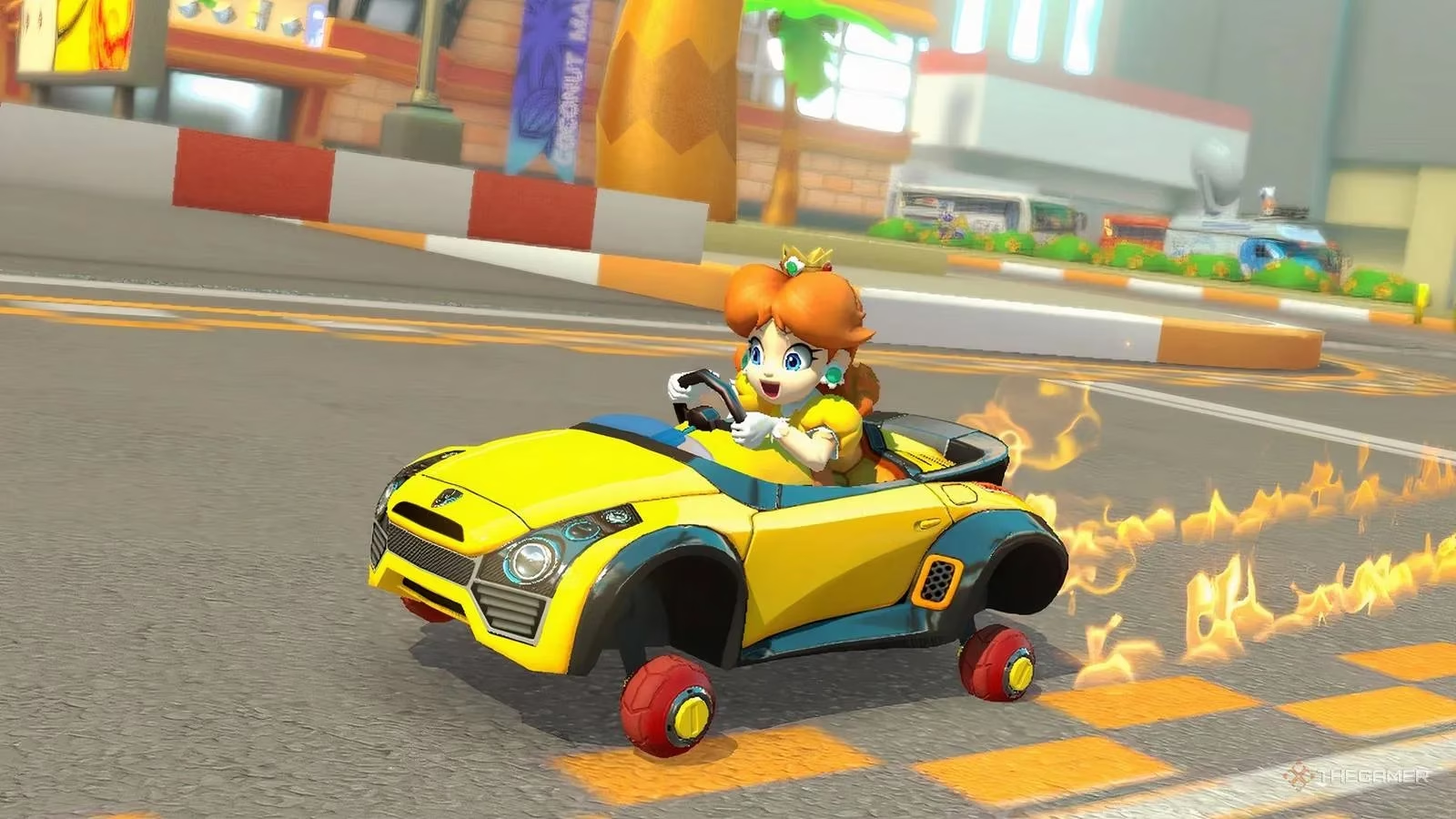
First seen in Mario Kart Wii (2008) and brought to the Golden Dash Cup via Booster Wave 1, Coconut Mall lets racers drive straight through a shopping center. The former mall employee knew firsthand that display cars rarely roll indoors gracefully, but if the game could do it, why not reality? The lower path through the food court offers a safer route, circumventing the jump where Shy Guys spin in circles. With a bit of Dukes of Hazzard flair and strict avoidance of the upper booster ramp, a sedan could roll past storefronts and escalators without clipping a fountain.
Yoshi Valley
This Mario Kart 64 classic (1996), now part of the Leaf Cup, features a breathtaking first drift where a wide turn can shave seconds. The driver confessed the urge to gun it for a purple boost would be his greatest enemy—one misjudged slide and the car would tumble into the valley below. The winding paths eventually converge, so patience and a steady steering wheel would win the day. He didn’t love the idea of dodging giant rotating eggs at the end, but overall, Yoshi Valley’s multiple routes felt eerily similar to an off-road trail drive.
Shroom Ridge
Debuting in Mario Kart DS (2005) and landing in the Lucky Cat Cup with Booster Wave 1, Shroom Ridge is a cliff-hugging highway with serpentine bends. The driver, who commutes on freeways six times a week, recognized the thrill but knew real-world physics don’t forgive drift boosts. Approaching the winding asphalt with the caution of a rainy-day commuter—no purple sparks, no handbrake slides—he could soak in a scenic, if white-knuckled, drive. The proximity to unscalable drops would keep his speed in check.
Yoshi Circuit
From Mario Kart Double Dash (2003) and resurrected in the Egg Cup, this track is shaped exactly like its namesake dino. The driver was stunned when he first noticed the silhouette from an aerial view. The early waterfall section, which he’d never mastered in-game, would be an instant no-go for his sedan—water plus combustion engines don’t mix. The spines along Yoshi’s back, bristling with Piranha Plants, present a slalom of bite hazards. Yet with a clean line through the tail and head sections, a four-door could mimic the shape without getting devoured.
Moonview Highway
This Wii-era course (2008) joined the Feather Cup in Booster Wave 5, and despite its perilous night-time traffic, it earned a spot. The driver worried most about hidden bomb cars lurking around blind corners and the narrow surfboard-shaped platforms that would bottom out a sedan instantly. He’d ghost the walls, ignore boost-pad shortcuts, and treat the highway like a real-life midnight drive—headlights on, cruise control off, and no reckless overtaking. The city lights glowing in the distance would make up for the constant threat of a fiery collision.
Mario Circuit 3
Hailing from Super Mario Kart (1992) and now a Turnip Cup staple via Booster Wave 2, this classic circuit represents the purest go-kart experience. The driver, too young for the SNES era, fell in love with its simplicity after unlocking it in Deluxe. Wide, colorful pavement, gentle curves, and minimal off-road punishment meant his Cruze could lap it comfortably. The sole hazard? Pipes blocking the inner lane on one corner, but nothing a patient driver couldn’t navigate. It looked, he mused, like a perfect afternoon rental-track outing.
Moo Moo Meadows
Appearing first in Mario Kart Wii (2008) and occupying the Shell Cup, this pastoral course blends farmland with jumps. The driver couldn’t resist the charm—every passenger’s duty is to shout “cows!” at grazing cattle. The figure-eight layout through dirt and hay bales would require lifting off the gas over ramps to avoid catching air, while sidestepping the Monty Moles that pop up like speed bumps. As long as the herd stayed off the driving line, a sedan could enjoy a delightfully scenic, udder-ly peaceful country drive.
Baby Park
The chaotic oval from Mario Kart Double Dash (2003) reappeared in the Crossing Cup, and it became the driver’s favorite online battleground. In terms of real-life feasibility, Baby Park is basically a beginner’s racetrack: a smooth, short loop where left turns dominate. The lack of elevation change and predictable curve radius make it the easiest circuit for a street car. He noted that if professional NASCAR drivers can handle “go fast, turn left,” then surely a Chevy Cruze can manage Baby Park—provided no one chucks a shell at the windshield.
After examining these ten tracks, the gamer concluded that while Mario Kart thrives on fantasy, a surprising number of its courses could serve as backdrops for a very cautious road trip. The keys are simple: ignore drift boosts, respect the train crossings, and, most importantly, drive like there’s a bob-omb in the trunk.