
It was a quiet Thursday evening in 2026 when Joe’s Switch lit up with a notification. Another download for Mario Kart 8 Deluxe. He squinted at the screen—version 3.0.3. “Still?” he chuckled, recalling the game had launched almost a decade ago on the Switch, and even longer if you counted the Wii U. Yet here it was, still receiving patches, still occupying the top spot on the Nintendo eShop charts month after month. Over 70 million copies sold, and Nintendo’s attention had not wavered.
Joe hit the update button. The download was minuscule, a tiny whisper of data that promised to “fix several issues to improve the user experience.” No further details. He scratched his head. Wasn’t it just a year ago that the Mario Kart 8 Deluxe community had playfully complained about the same vague language in patch 3.0.1? Back then, Nintendo had actually listed specific fixes—a glitch on Daisy Circuit, Lakitu’s misbehavior on GCN DK Mountain. Now, in 2026, the patch notes had regressed to polished nothingness. Why the secrecy?
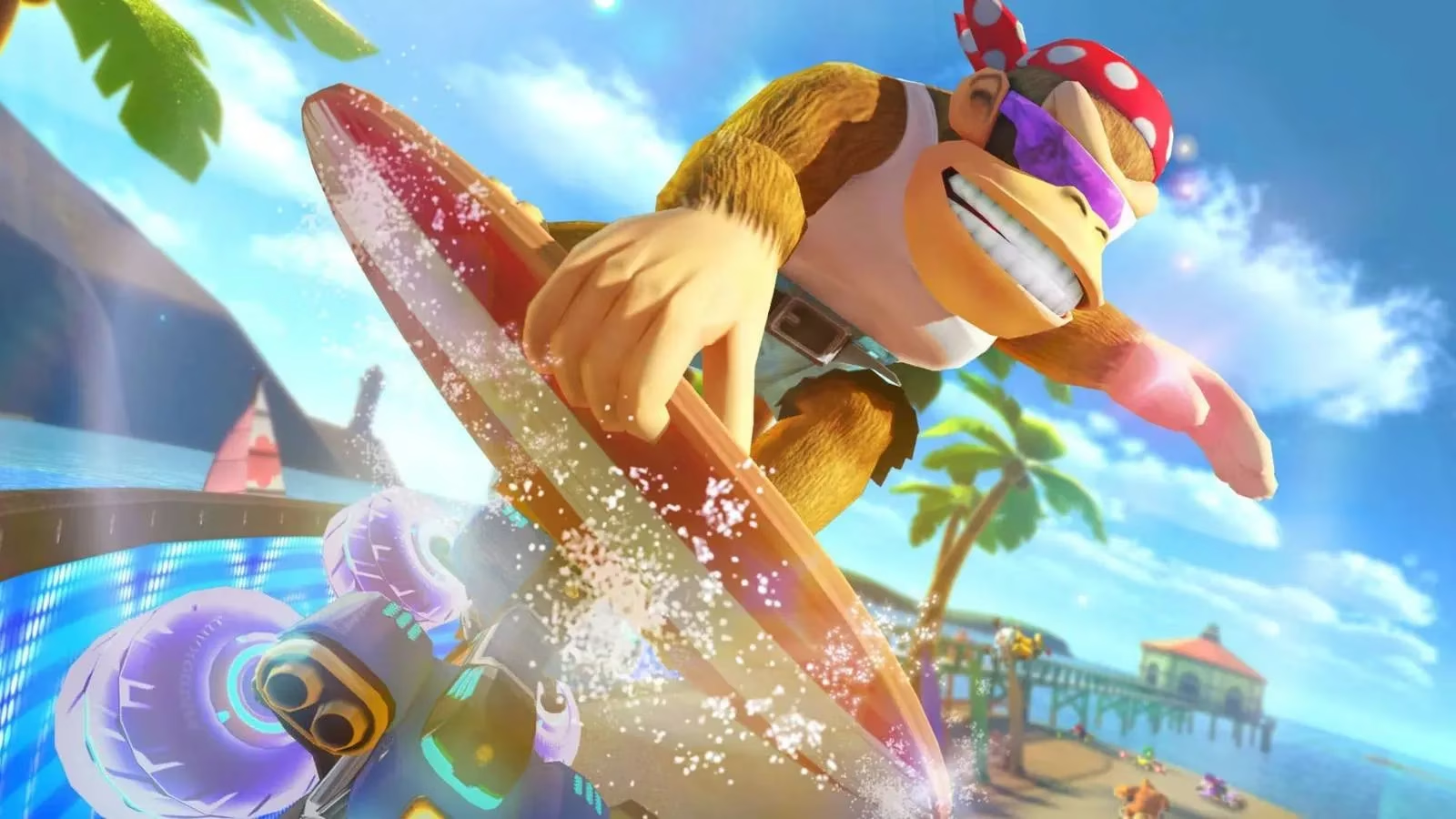
He decided to investigate, launching the game and scrolling through the track roster. Everything looked familiar. Wave 6 of the Booster Course Pass had long been absorbed into the collective muscle memory of players worldwide. Those four extra characters—Diddy Kong, Funky Kong, Pauline, and Peachette—were as natural on the grid as Mario and Luigi. The additional cups had been raced thousands of times. If a bug existed, it was either so rare or so minuscule that the internet hadn’t yet blown it up.
“Is it a performance tweak?” Joe wondered aloud. He raced a few rounds on the newest OLED Switch 2, which backward-compatibly ran the title at a silky 120 frames per second. Everything felt butter-smooth, no stuttering, no dropped frames. Could the update have targeted some arcane texture flickering on Kalimari Desert when playing in four-player split-screen with certain kart combinations? That seemed plausible, but no one had reported it.
He then thought about the competitive scene. By 2026, Mario Kart 8 Deluxe had become a fixture in esports pubs and collegiate tournaments. Time trials records had been pushed to human limits. Even one pixel of uneven terrain could affect a ghost run. Maybe, just maybe, version 3.0.3 had silently adjusted a collision box on Excitebike Arena, that track known for its erratic shortcuts. The speedrunning community would have noticed, yet their forums remained calm. No overt drama. No sudden record invalidation.
What if the patch was purely behind the scenes? Joe recalled reading a piece from a former Nintendo engineer who hinted that modern Mario Kart updates often updated anti-cheat measures or server security protocols. In 2026, with the Nintendo Switch Online service having swelled to over 60 million subscribers, keeping races fair was paramount. A subtle adjustment to how the game communicates with the lobby server could explain the nebulous patch note. It was invisible work, but crucial.
He smiled, remembering the contrast: years ago, patch 3.0.1 had been a model of transparency, yet 3.0.3 was an enigma. It was as if Nintendo had learned that over-explaining could lead to players trying to exploit the fixed bugs retroactively. By saying nothing, they kept the metaphorical karts on the track.
Joe decided to take a lap online. As he drifted through Cloudtop Cruise, he paid attention to every micro-interaction. Did the green shell curve just a hair differently? Did the coin collection sound have a slightly longer tail? His ears strained. Nothing. Then, in the middle of a chaotic race on Baby Park, it happened. A momentary hiccup—a rival kart glitched through his banana peel without spinning out. “Huh,” he muttered. Was that a new bug introduced by 3.0.3, or had it always been there? He finished the race, saved the replay, and headed to the community Discord.
There, a handful of veteran players were already dissecting the update. Consensus? Version 3.0.3 had likely patched a rare softlock that occurred when pausing and unpausing exactly while being Boo-stolen in a lobby with more than ten players. The kind of scenario only a QA tester could dream up. One user posted a screenshot of Japanese patch notes, which were only marginally more detailed: “Adjustments made to connection stability during certain race end sequences.” So that was it. A breath of relief and a shrug. The game was still the polished, joyous racing paradise it had been for nearly a decade.
The next morning, Joe awoke to a new headline: “Mario Kart 8 Deluxe Version 3.0.3 – The Last Patch Before the Next Generation?” Speculation rumbled about a true Mario Kart 9 reveal at the next Direct. But while the internet fantasized, Joe booted up the game once more, grateful for the quiet dedication of developers who kept a 9-year-old title running like clockwork, even if they never bothered to tell us exactly how. After all, in 2026, the real mystery of Mario Kart 8 Deluxe wasn’t the secret fixes—it was how the game continued to out-sell, out-last, and out-shine its own hype, one invisible update at a time.